

Understanding answer engine optimization (AEO) vs. traditional SEO has become mission-critical for content managers and marketing leaders as search shifts toward AI-generated responses, voice results, and zero-click experiences. While page ranking on Google is still important (for now), success increasingly depends on whether a brand stays visible when an AI system summarizes an answer. 
Traditional SEO still drives performance for long-form content, rankings, and organic traffic. AEO, however, determines whether a brand appears in AI Overviews, featured snippets, and voice search. Answer engine optimization and traditional SEO models run in parallel, and they rely on different signals, content structures, and measurement frameworks.
This guide breaks down AEO vs. SEO, where each one is most effective, and how teams can combine the two. The post also highlights tools — including HubSpot’s AEO Grader, Website Grader, Marketing Hub, and Content Hub — that help teams build content for both AI-driven and classic search visibility.
Table of Contents
- Why Answer Engine Optimization Is Different From Traditional SEO
- How Answer Engine Optimization vs. Traditional SEO Differ in Practice
- When to prioritize AEO strategies over SEO hybrid approaches
- Measuring AEO Alongside Traditional SEO
- Tradeoffs of Answer Engine Optimization vs. SEO
- Frequently Asked Questions About Answer Engine optimization vs. traditional SEO
Why Answer Engine Optimization Is Different From Traditional SEO
Answer engine optimization is different from traditional SEO because AEO prepares content for direct answers in AI Overviews, voice search, and featured snippets, while SEO focuses on ranking full pages in organic search results. These approaches support two very different ways content is evaluated and surfaced online. One is built to extract short, precise answers, and the other to assess full-page relevance and authority.
AEO revolves around a simple idea: Answer engines need structured, explicit, and skimmable information to cite. AI systems work by identifying a clear definition, recognizing supporting context, and validating its structure with schema and internal linking. Traditional SEO takes a broader view by evaluating page depth, intent alignment, crawlability, backlinks, and topic authority.
These patterns show how answer engine optimization and traditional SEO interpret structure differently:
- AEO prioritizes direct answers, which power AI Overviews.
- SEO prioritizes full-page rankings, which drive organic traffic.
- AEO improves zero-click visibility, which drives AI citations.
- SEO strengthens long-form content, which drives domain authority.
Semantic signals shape how content shows up across AI-driven results and traditional search. Content managers who optimize for answer engine optimization vs. SEO (or vice versa) often see strong performance in one area and unexplained gaps in the other.
While good SEO can lead to some AEO wins, it is not a substitute for explicitly structured answers, schema, and consistent terminology. Content that only follows SEO conventions may rank well but still fail to appear in AI Overviews or answer surfaces.
What Answer Engine Optimization Focuses On
Answer engine optimization focuses on producing structured answers that AI systems can extract and cite. AEO requires clear definitions, direct explanations, and schema that reinforces meaning. It works best when content presents the answer immediately and follows with concise context.
AEO increases the likelihood of appearing in:
- AI Overviews.
- Featured snippets.
- Voice search results.
- LLM-generated citations.
- Chat-style answer panels.
These elements help AI interpret content with fewer assumptions and increase the chances of generating correct citations.
What Traditional SEO Focuses On
Traditional SEO focuses on helping full pages rank in search results through authority, depth, and technical performance. SEO emphasizes comprehensive content, strong linking, and clean metadata that help search engines assess relevance. SEO relies on:
- Topic clusters.
- Backlinks.
- Keyword alignment.
- Metadata optimization.
- Page experience and Core Web Vitals.
These elements signal that a page deserves to rank for specific keywords.
Why Content Teams Need Both
Content teams need both AEO and SEO because AI-driven experiences highlight short answers while search engines continue to evaluate full pages. Answer-focused content helps brands appear in zero-click surfaces, and zero-click visibility supports early-stage awareness. Meanwhile, detailed pages drive conversions and reinforce topical depth, and stronger topical depth increases the credibility of answer blocks.
As AI-generated results expand across search engines and devices, teams that balance AEO and SEO maintain visibility wherever users look for information, whether they scroll through SERPs, trigger a voice prompt, or read an AI-generated summary.
How Answer Engine Optimization vs. Traditional SEO Differ in Practice
Answer engine optimization differs from traditional SEO in the way content is structured, discovered, evaluated, and surfaced. AEO prioritizes short, extractable answer blocks for AI search, while SEO prioritizes deep, comprehensive pages that rank in search results.
Below is a clear comparison of answer engine optimization vs. traditional SEO that content managers can use during planning.
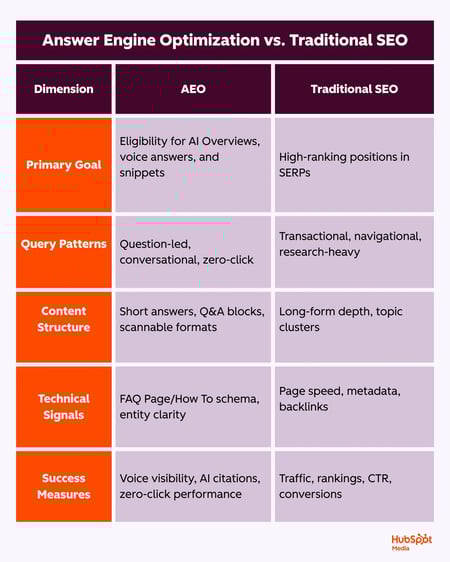
Answer Engine Optimization vs. Traditional SEO: 5 Key Differences
|
Dimension |
AEO |
Traditional SEO |
|
Primary Goal |
Eligibility for AI Overviews, voice answers, and snippets |
High-ranking positions in SERPs |
|
Query Patterns |
Question-led, conversational, zero-click |
Transactional, navigational, research-heavy |
|
Content Structure |
Short answers, Q&A blocks, scannable formats |
Long-form depth, topic clusters |
|
Technical Signals |
FAQ Page/How To schema, entity clarity |
Page speed, metadata, backlinks |
|
Success Measures |
Voice visibility, AI citations, zero-click performance |
Traffic, rankings, CTR, conversions |
Pro tip: HubSpot’s AEO Grader analyzes answer readiness across structured content, schema, and semantic clarity, a capability most SEO tools don’t yet offer.
1. Goals
AEO focuses on helping content appear as direct answers, while SEO focuses on helping full pages rank for relevant queries. These goals serve different stages in the user journey. Where AEO prioritizes clarity in the first sentence, SEO prioritizes depth, UX, and topic relevance throughout the page.
When AEO and SEO goals align, answer visibility supports early discovery, and sustained rankings support ongoing traffic and conversions.
2. Query Patterns
AEO is shaped by question-based queries, while SEO accommodates a wider range of intent, including transactional, navigational, and research-heavy queries. Users tend to trigger answer engines when they type or speak questions, and they turn to SERPs when they need comparisons, pricing, or detailed context.
Clear questions improve answer extraction, and stronger contextual pages improve ranking stability.
3. Content structure
AEO requires short, structured answers placed high on the page, while SEO requires long-form content built around topic clusters. AEO content reads like a direct response to a specific question. SEO content reads like an in-depth guide or resource.
Many high-performing pages use a hybrid structure:
- The first section answers the question directly.
- Subsequent sections expand into SEO-rich explanations.
- FAQs reinforce alternative phrasing and related intent.
When AEO and SEO strategies work in collaboration, answer blocks improve AI eligibility, and long-form depth strengthens the surrounding cluster.
4. Technical signals
AEO relies on schema markup, entity clarity, and consistent terminology, while SEO relies on page performance, metadata optimization, and internal linking. Schema gives AI systems a structured map of meaning, and technical SEO supports discoverability and crawlability.
When AEO and SEO work in parallel, schema sharpens the interpretation of content, and technical SEO ensures the page can be found, indexed, and ranked.
5. Success metrics
AEO measures visibility in answer surfaces, while SEO measures performance in search rankings and organic traffic. AEO metrics include AI Overview presence, voice answer visibility, and zero-click CTA engagement. SEO metrics include keyword rankings, organic sessions, and conversion rates from search.
Together, AEO and SEO metrics provide a broader picture of visibility — both answer-level influence early in the journey, and page-level conversions later on.
When to prioritize AEO strategies over SEO hybrid approaches
Content managers often need to decide when to lead with answer engine optimization vs. traditional SEO and when a hybrid approach will drive better results. AEO should be a priority for marketers when users want clear, direct answers, while SEO becomes essential when they need depth, comparison, or evaluation.
The four scenarios below outline how to think about this balance in practice.
AEO vs. Traditional SEO Overview
|
Scenario |
First Priority (AEO vs. SEO) |
Why It Matters |
What Could Change the Priority |
How the Other Strategy Supports Success |
|
Audience uses question-based or conversational queries |
AEO |
Ensures the best answer surfaces quickly while still giving a path to deeper content when needed. |
If intent shifts toward evaluation or comparison that needs more detail |
SEO provides deeper context, related articles, and topic-cluster support |
|
Topic requires depth, comparison, or buyer evaluation |
SEO |
Helps buyers compare options, understand tradeoffs, and move toward a decision—not just get a one-line answer. |
If the query is simplified into a definition-style or “what is…” search |
AEO helps capture snippets and AI Overview placements that point back to the in-depth page |
|
Goal is visibility in AI Overviews, voice results, or LLM citations |
AEO |
Increases the chances that answer engines quote the brand directly instead of a competitor. |
If the query becomes more commercial, feature-focused, or brand-comparison oriented |
SEO strengthens domain authority and reinforces the credibility of the cited page |
|
Need for both early discovery and long-form performance |
Hybrid (AEO + SEO) |
Protects visibility across changing SERP layouts and AI experiences by not depending on a single channel. |
If AI begins to dominate more informational results or SEO competition increases for key terms |
AEO drives quick, zero-click visibility; SEO sustains traffic, engagement, and conversions over time |
1. When audiences search using question-based queries
AEO should take the lead when audiences begin with clear, question-based queries such as “what is…,” “how does…,” or “when should…”. These searches trigger answer-oriented systems that surface structured, concise responses rather than long lists of links.
If the decision is answer engine optimization vs. SEO, AEO works well here because answer engines look for straightforward definitions, consistent phrasing, and answer blocks placed high on the page. SEO still plays a supporting role by anchoring that short answer within a broader topic cluster that provides depth for users who click through.
When intent shifts from asking a question to evaluating options, SEO becomes increasingly important because audiences need more than a one-sentence response.
- Answer engine optimization vs. traditional SEO: AEO should take the lead because answer engines elevate short, structured explanations.
- User intent: Users want a fast, factual answer to a “what is,” “how does,” or “when should” question.
- Why it matters: Strong AEO performance ensures the brand appears in AI Overviews, snippets, and voice responses before users view traditional SERPs.
- What could shift the priority: If intent moves from broad understanding to evaluating options, SEO becomes more important.
- How SEO supports success: SEO provides deeper context, internal linking, and reference content for users who move beyond the initial answer.
2. When the topic requires detail, comparison, or decision support
SEO should take the lead when audiences need comprehensive information, a structured explanation, or a comparison that cannot be delivered in a short answer. Product research, pricing, and evaluation queries rely on full-page depth, internal linking, and clear visual hierarchy.
AEO still contributes through answer blocks at the top of the page that help secure snippets and AI visibility. These blocks create early-stage exposure, while the SEO-driven sections below guide users through more complex questions.
If the query can be answered with a simple definition, AEO temporarily becomes more influential. But the moment depth becomes necessary, SEO determines performance.
- Answer engine optimization vs. traditional SEO: SEO should take the lead because users need detailed information—not just a concise answer.
- User intent: Users want structured evaluation, including comparisons, pricing, pros and cons, or specific use cases.
- Why it matters: SEO ensures users can navigate long-form content that informs decisions and supports the buyer journey.
- What could shift the priority: If the query shifts toward early-stage or definition-style searches, AEO may briefly take precedence.
- How AEO supports success: AEO helps capture snippets and AI Overview placements that guide users toward the in-depth page.
3. When the goal is visibility inside AI Overviews, voice results, or LLM citations
AEO should take the lead when teams want to appear inside AI-generated summaries, voice responses, or assistant-style answers. These systems look for short, stable explanations, consistent terminology, and schema that reinforces meaning.
SEO supports this work by helping search engines evaluate the authority of the domain, which improves how reliably those answers surface. Strong authority increases answer visibility, and consistent answer structure increases citation accuracy.
When the query becomes more commercial or comparison-driven, SEO regains priority because the audience’s needs shift beyond a single extracted explanation.
- Answer engine optimization vs. traditional SEO: AEO should take the lead because AI systems rely on clear definitions, consistent terminology, and structured answers.
- User intent: Users expect a quick, authoritative explanation delivered through AI summaries or voice responses.
- Why it matters: AEO improves the likelihood that answer engines cite the brand directly instead of a competitor.
- What could shift the priority: If the query becomes more commercial, feature-focused, or comparison-driven, SEO becomes more important.
- How SEO supports success: SEO strengthens domain authority and reinforces the credibility of the page being cited.
4. When teams want sustained organic traffic and answer-level visibility
A hybrid approach should take the lead when teams want both early visibility in answer surfaces and ongoing traffic from long-form search results. Hybrid pages integrate AEO and SEO: a structured answer block at the top, followed by detailed sections that support rankings, conversions, and internal linking.
AEO ensures the page appears in AI Overviews and snippets, while SEO ensures the page remains competitive on traditional SERPs. When these elements work together, answer surfaces drive early discovery, and rankings support the full buyer journey.
If either visibility type becomes more dominant for a specific query—such as when AI systems take over more informational results or when competitive SEO intensifies—the balance shifts accordingly.
- Answer engine optimization vs. traditional SEO: A hybrid (AEO + SEO) approach should take the lead because the page must serve both AI surfaces and classic SERPs.
- User intent: Users may want a quick definition upfront, followed by deeper explanations, comparisons, or examples.
- Why it matters: A blended strategy protects visibility across both AI-driven results and traditional search rankings.
- What could shift the priority: If AI begins dominating more informational queries, AEO becomes more influential; if SEO competition increases, SEO becomes more critical.
- How AEO and SEO support success together: AEO provides early visibility and snippet capture, while SEO ensures long-term rankings, engagement, and conversions.
Measuring AEO Alongside Traditional SEO
Measuring AEO alongside traditional SEO requires combining answer-level visibility with classic page-level metrics to understand how content performs across AI-generated results and search engines.
AEO focuses on whether content is cited, surfaced, or summarized by AI systems, while SEO focuses on how full pages rank, attract traffic, and convert. When these metrics are evaluated together, content managers get a complete view of how audiences discover and engage with their brand.
It’s not a case of answer engine optimization vs. traditional SEO. AEO and SEO do not replace each other. They reinforce each other throughout the search journey. Answer visibility reflects early-stage discovery, and page performance reflects deeper evaluation. When both are strong, answer clarity improves AI citations, and strong pages reinforce the authority behind those answers.
|
Metric |
AEO Focus |
SEO Focus |
Measurement Tool Example |
|
AI Overview & Voice Answers |
Appearing in AI-generated summaries and voice responses |
Appearing in SERP answer boxes & rich results |
AEO Grader, Search Console |
|
Snippets & Rich Results |
Extractable, structured answers |
Enhanced SERP visibility and CTR |
Search Console |
|
Zero-Click Engagement |
Smart CTA interactions inside AI results |
Assisted conversions & behavior before page visits |
|
|
Keyword Rankings |
Entity clarity and definition alignment |
SERP positioning and demand visibility |
|
|
Topic Cluster Performance |
Terminology consistency across answers |
Authority across pillar and subtopic content |
Topic Cluster Tool |
|
Conversions from Organic + Zero-Click Activity |
Early-stage influence from answer surfaces |
On-page conversion outcomes |
1. AI Overview and voice answer visibility
AI Overview and voice answer visibility measure whether content appears inside AI-generated summaries and voice assistant responses—surfaces that increasingly precede traditional SERPs. For AEO, this metric is foundational because answer engines rely on short, structured explanations; for SEO, it aligns with how rich results and featured snippets reinforce authority.
How to track AI Overview and voice answer visibility as an AEO vs. SEO performance metric:
- Monitor appearances in AI Overviews, Gemini snapshots, and Perplexity citations.
- Review voice responses (Siri, Alexa, Gemini) for accuracy.
- Check Search Console for snippet-like answer patterns.
- Assess answer block clarity and schema markup.
Helpful HubSpot Tools for Measuring This AEO/SEO Metric:
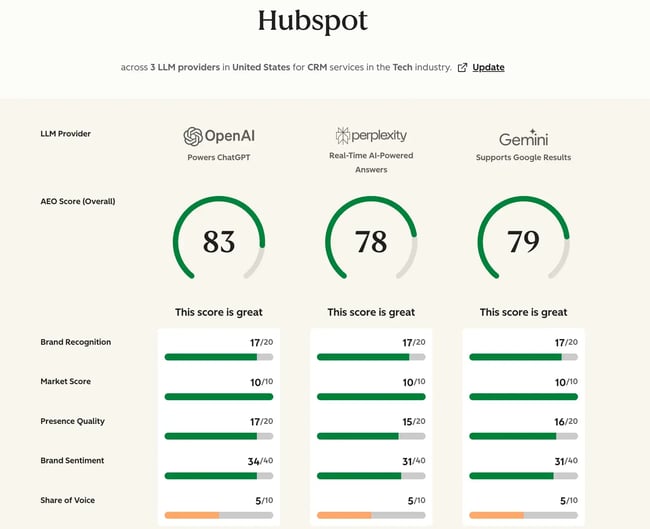
- AEO Grader, which evaluates answer structure, schema readiness, and clarity.
- AEO Guide, which offers structured recommendations for strengthening answer eligibility.
2. Snippet and rich-result performance
Snippet and rich-result performance measures how often content is elevated into featured snippets, FAQ panels, and structured SERP enhancements. For AEO, snippet clarity signals that the page delivers extractable answers. For SEO, snippets boost visibility and drive incremental CTR.
How to track snippet and rich-result performance as an AEO vs. SEO metric:
- Monitor featured snippet wins and FAQ rich results through Search Console.
- Add an FAQ Page or How To schema to improve eligibility.
- Track impressions and CTR for snippet-led keywords.
Helpful HubSpot Tools for This AEO/SEO Metric:
- Content Hub, where users can add schema and optimize semantic structure.
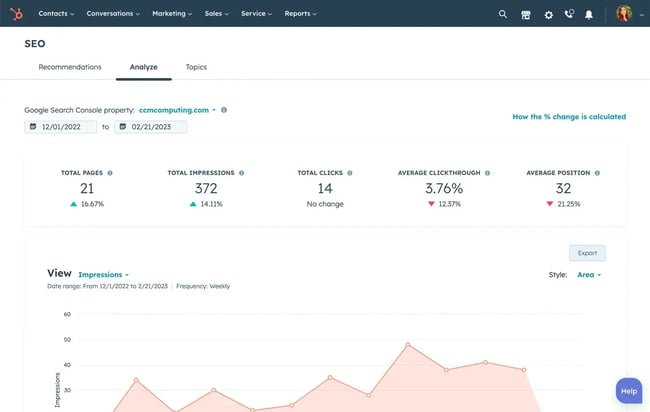
- Website Grader, which identifies technical blockers affecting snippet eligibility.
- Marketing Hub SEO Tools, which can validate metadata, headings, and internal linking.

3. Zero-click CTA engagement
Zero-click engagement measures actions taken directly inside AI results or snippets — before users reach a webpage. AEO treats this as a primary engagement metric; SEO traditionally evaluates what happens after the click.
How to track zero-click CTA engagement as an AEO vs. SEO metric:
- Add smart CTAs to answer blocks.
- Track CTA engagement inside Marketing Hub.
- Log AI Overview link interactions when available.
- Attribute assisted conversions to these interactions through CRM data.
Helpful HubSpot Tools for This AEO/SEO Metric:
- AEO Grader, which confirms an answer structure that supports CTA surfacing.
4. Organic keyword rankings and impressions
Organic keyword rankings and impressions measure how well full pages perform in traditional SERPs. These metrics rely on strong content depth, internal linking, and technical SEO.
They matter because high-ranking pages strengthen overall authority, and stronger authority improves how AI systems interpret and trust associated answer blocks.
How to track organic keyword rankings and impressions as an AEO vs. SEO metric:
- Monitor rankings and impressions using HubSpot SEO Tools + Search Console.
- Track ranking stability across the topic cluster.
- Use ranking trends to refine answer definitions.
Helpful HubSpot Tools for This AEO/SEO Metric:
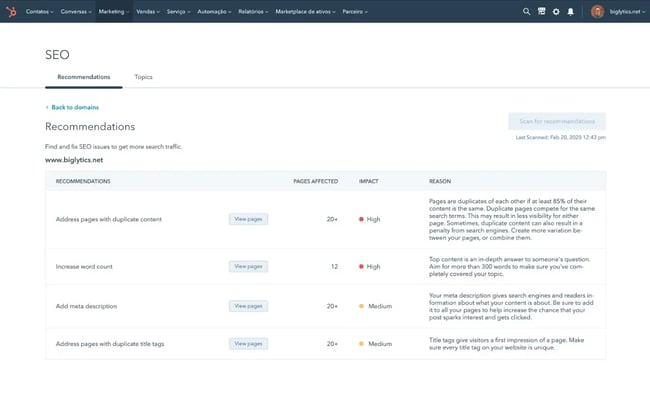
- HubSpot SEO Tools, which analyze rankings, internal linking, and optimization opportunities.
- Website Grader, which can run diagnostics for technical blockers.
- HubSpot SEO Recommendations Library to help teams prioritize improvements based on impact.
5. Topic cluster performance
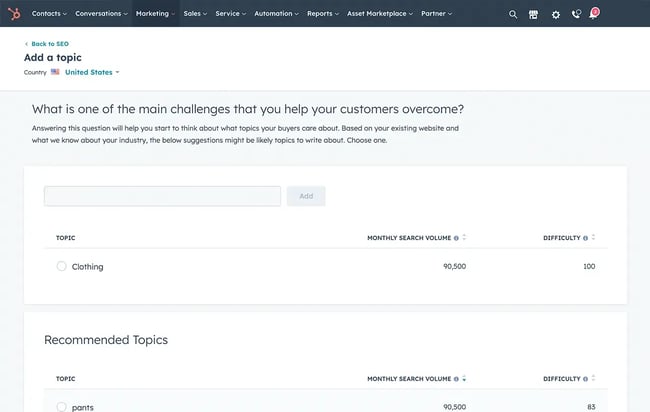
Topic cluster performance measures how well a group of related pages performs collectively, reflecting the connected authority of the entire content ecosystem. Clusters support both AEO and SEO by reinforcing relationships between terms and concepts.
This metric matters because strong clusters increase the clarity of definitions and the stability of rankings, and strong clarity improves answer eligibility.
How to track topic cluster performance and impressions as an AEO vs. SEO metric:
- Review pillar and subtopic performance in Marketing Hub.
- Evaluate internal linking and terminology consistency.
- Ensure cluster pages support definitions used in answer blocks.
Helpful HubSpot Tools for This AEO/SEO Metric:
- Marketing Hub SEO Tools, which build topic clusters, monitor performance, and reinforce semantic structure.
- Content Hub, which ensures consistent terminology and entity cues across the cluster.
6. Conversion rate from organic and zero-click activity
Conversion rate from organic and zero-click activity measures how effectively content turns visibility into leads, trials, or revenue. AEO influences early awareness; SEO influences evaluation-stage conversions.
This metric matters because it ties answer visibility to actual outcomes inside the CRM, making it easier to demonstrate the value of AEO beyond impressions.
How to track conversion rate from organic and zero-click activity as an AEO vs. SEO metric:
- Attribute conversions from organic traffic using CRM attribution.
- Monitor smart CTA clicks + AI Overview interactions.
- Combine organic session conversions with zero-click influence.
Helpful HubSpot Tools for This AEO/SEO Metric:
- Marketing Hub Attribution Reports, which tie AEO- and SEO-driven interactions to revenue outcomes.
- AEO Grader, which optimizes answer blocks to improve early-stage influence and AI-driven discovery.
- HubSpot Academy SEO Course that trains teams to interpret unified AEO + SEO performance data.
Tradeoffs of Answer Engine Optimization vs. SEO
Answer engine optimization vs. traditional SEO introduces practical tradeoffs that content managers need to consider when planning strategy, structuring content, and allocating time. AEO improves visibility in AI answers and voice responses, while SEO anchors visibility in SERPs and long-form content. Both are essential, but each creates different operational requirements, content formats, and measurement challenges.
Below are the five tradeoffs that matter most when deciding how to balance the two.
1. Content format flexibility
AEO requires tight, structured answers, while SEO allows for long-form detail and broader narrative flexibility. Answer engines need concise definitions, direct phrasing, and predictable structure. SEO accommodates depth, storytelling, subheadings, and multimedia.
- AEO perspective: favors short answers, consistent terminology, and clear schema markup.
- SEO perspective: supports long-form guides, examples, visuals, and broader context.
- The tradeoff of AEO vs. SEO: AEO tightens the format; SEO expands the amount and style of content you can include.
- What to consider: start pages with AEO-friendly answer blocks, then expand into SEO-rich depth below.
2. Time investment and maintenance
AEO requires frequent updates to answer blocks, while SEO requires broader updates across entire pages or clusters. AI systems evolve quickly, so AEO-focused content must remain current and aligned with new phrasing patterns. SEO requires updating metadata, internal links, and content depth.
- AEO perspective: requires regular updates to phrasing, schema, and answer clarity as AI models evolve.
- SEO perspective: requires periodic updates to page depth, internal linking, and metadata across clusters.
- The tradeoff of AEO vs. SEO: AEO maintenance is fast but ongoing; SEO maintenance is slower but more comprehensive.
- What to consider: audit answer blocks monthly and refresh SEO pages or clusters quarterly.
3. Measurement complexity
AEO relies on emerging visibility metrics, while SEO relies on established analytics frameworks. This makes measurement one of the clearest trade-offs in AEO vs. SEO.
- AEO perspective: tracks AI Overview presence, voice answers, and zero-click CTA interactions.
- SEO perspective: tracks keyword rankings, SERP impressions, traffic, and on-page conversions.
- The tradeoff of AEO vs. SEO: AEO visibility is harder to quantify; SEO performance is easier to benchmark and compare.
- What to consider: tie both AEO and SEO touchpoints to revenue using CRM-based attribution.
4. Impact on the user journey
AEO influences early-stage discovery, while SEO influences evaluation and conversion. Users often encounter AEO content through AI answers or voice responses before they ever see the SERP. SEO remains critical when users compare options, explore features, or make decisions.
- AEO perspective: drives top-of-funnel reach by surfacing direct answers in AI and voice results.
- SEO perspective: supports mid- and bottom-funnel research, comparison, and conversion pathways.
- The tradeoff of AEO vs. SEO: AEO builds awareness; SEO drives decisions and outcomes.
- What to consider: high-performing content usually needs both AEO to be found and SEO to convert.
5. Level of control
AEO provides limited control over how answers are surfaced, while SEO gives content managers more control over ranking, snippets, and page experience. Answer engines pull content in ways that are not always predictable or transparent. SEO provides clearer signals and more established levers.
At a glance:
- AEO perspective: depends on AI extraction logic, which varies across systems and updates.
- SEO perspective: influenced by metadata, technical SEO, structured content, and user experience.
- The tradeoff of AEO vs. SEO: AEO increases visibility but with less control; SEO increases control but requires deeper investment.
- What to consider: consistent terminology and schema markup increase stability for both AEO and SEO.
Frequently Asked Questions About Answer Engine optimization vs. traditional SEO
Does AEO replace traditional SEO?
AEO does not replace traditional SEO. The two serve different functions and work best together instead of being treated as AEO vs. SEO in isolation. AEO improves visibility inside AI answers, voice responses, and zero-click surfaces, while SEO strengthens page rankings, traffic, and on-page conversions. Content teams typically get the strongest results when both approaches support one another—AEO for early discovery and SEO for deeper evaluation.
Which schema types matter most for AEO?
FAQ Page schema and How To schema matter most for AEO because they provide the structured patterns that answer engines rely on. These schema types help AI systems interpret definitions, steps, and short answers more consistently. Organization, Article, and Breadcrumb schema also support clarity, but FAQPage and HowTo schema typically offer the strongest lift for answer extraction.
How often should answer blocks be refreshed?
Answer blocks should be refreshed monthly because AI models evolve faster than traditional SERP algorithms. Refreshing ensures phrasing remains accurate, terminology stays consistent, and schema continues to match current extraction patterns. For deeper SEO-focused pages, quarterly updates are usually sufficient unless rankings begin to shift.
How do brands appear in AI Overviews and voice results?
Brands appear in AI Overviews and voice results by providing clear, structured answers that match how users phrase questions. Short definitions, consistent terminology, and supporting schema increase the likelihood of extraction. Strong topic clusters, internal linking, and entity clarity further reinforce eligibility across both AI and traditional search systems.
What’s the best way to start AEO if the team is small?
Small teams should start AEO by identifying the top 10–15 high-value questions and building clear answer blocks for each. These blocks can be added to existing pages, supported with FAQ Page schema, and measured using tools like HubSpot’s AEO Grader. From there, content managers can expand into larger refresh cycles, cluster updates, and answer-level measurement.
How to Start Building a Unified AEO + SEO Strategy
A unified AEO + SEO strategy starts by recognizing that AI systems and search engines serve different but equally important roles in how people search today. It’s no longer a question of choosing answer engine optimization or traditional SEO. Modern visibility requires both.
In my experience, the biggest strategic shift was letting go of the assumption that visibility begins at the page level. AI systems often decide what to cite based on the first lines alone, which makes clarity a strategic priority, not something to build toward gradually. If the content never reaches the user, how strong the rest of the page is doesn’t matter.
Once I understood how AEO and SEO operate at different stages of the same journey, it became easier to approach them sequentially rather than as answer engine optimization vs. traditional SEO. AEO drives discovery by helping models interpret terminology and surface answers. SEO drives intent and evaluation by giving users the depth they need once they choose to click. Thinking in terms of discovery → intent created far more consistency in how content performed across both AI and traditional search surfaces.
If the goal is to build a unified AEO and SEO strategy, the strongest place to begin is understanding whether your existing content is answer-ready. HubSpot’s AEO Grader evaluates answer clarity, schema structure, and AI visibility. Run your content through the free AEO Grader to see how well it performs in AI search.





![12 social media trends marketers should watch in 2025 [new data]](https://firstonlineprofits.com/wp-content/uploads/2025/05/3dc1dfd9-2cb4-4498-8c57-19dbb5671820-6-440x58.png)



Last Comments