

An AEO strategy for SaaS won’t stray too far away from a good SEO strategy, but some tactics benefit AI search more than others, and it helps to know what these are. We all know that AI has shifted how brands earn visibility, and how visibility doesn’t equal clicks. But for SaaS, the way buyers conduct discovery and evaluation has changed disproportionately. 
It’s no longer enough to rank well in search results; the product, brand expertise, and differentiation need to be understood and surfaced accurately by AI-driven systems, especially during the buyer’s discovery and consideration phases.
In this guide, I share how SaaS teams can optimize for AEO. I’ve included why AEO strategy matters for SaaS, which strategies to prioritize, how to track success, and the tools that make AEO strategy easier.
Table of Contents
- Why AEO Is Important for SaaS Companies.
- AEO strategy for SaaS companies.
- AEO for SaaS: Ways to track success.
- Best AEO Tools for SaaS Marketing Teams
- Frequently Asked Questions About AEOf or SaaS.
Why AEO Is Important for SaaS Companies.
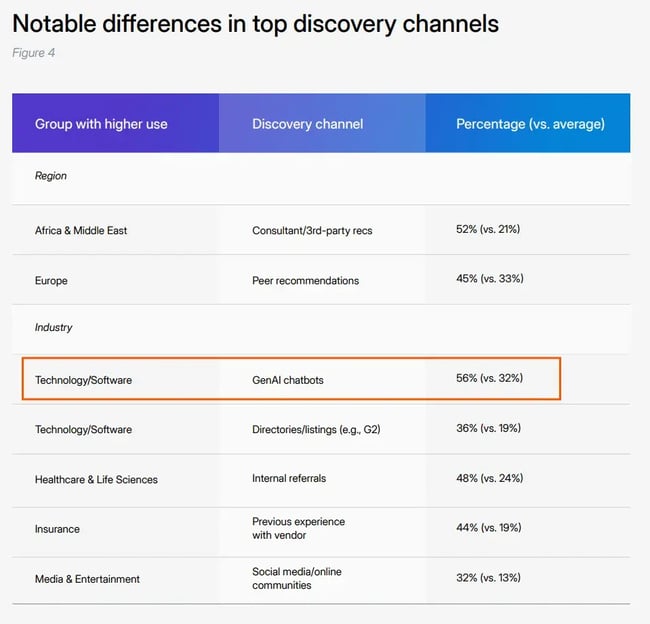
AI-driven answer engines now play a central role in how SaaS buyers discover and evaluate software. Responsive’s research, Inside the Buyer’s Mind, shows that B2B buyers begin vendor discovery using generative AI chatbots 32% of the time, compared to 33% via traditional web search.
When SaaS is isolated, the shift is far more pronounced. For SaaS buyers specifically, 56% now start their vendor research on generative AI tools.
SaaS brands are disproportionately at risk of missing out on opportunities if their brand doesn’t show up in AI search.
Unlike traditional search results, answer engines don’t simply rank pages. They summarize expertise from the website or knowledge base, compare options, and surface recommendations directly to the searcher and all within the AI interface.
The consequence: If a brand isn’t cited in AI-driven search results, potential buyers miss the brand as they‘re forming a shortlist of vendors; companies are out of the race at the earliest stage and won’t even make it to an evaluation or trial.
AEO strategy for SaaS companies.
The strategies below represent the areas SaaS teams should double down on for AEO. Each one supports traditional search performance, but more importantly, they increase the likelihood of being surfaced, referenced, and trusted by answer engines at high-intent moments in the buying journey.
1. Optimize for early-stage visibility that feeds evaluation.
To show up during learning and exploration queries, SaaS teams need to focus on how answer engines interpret and associate products with problems, use cases, and outcomes.
At a practical level, this means:
- Clearly defining the category and use cases so AI tools can associate the product with the right problems and buyer needs.
- Publishing explanatory content that answers “what is,” “how does,” and “when should you use” questions in plain, unambiguous language
- Using consistent terminology and positioning across core pages, documentation, and supporting content
- Structuring content for extraction with clear headings, short paragraphs, and direct answers that can be summarized by AI systems (more on this next)
AI-driven answer engines are most suitable for buyers who are learning, exploring, and sense-checking options before formal evaluation begins.
If a brand isn’t visible at this stage, it’s unlikely to make a buyer’s shortlist.
Research from McKinsey shows that 70% of AI-powered search users still ask top-of-funnel questions to learn about a category, brand, product, or service.
These early queries shape how AI search engines frame the market, which vendors they associate with specific use cases, and which products are repeatedly surfaced as “relevant” as the SaaS customer lifecycle progresses.
For SaaS buyers, this matters because vendor lists are formed early. Buyers typically start with a long list of potential solutions and around eight vendors, according to Responsive’s research, before narrowing it down to three or four for deeper evaluation.
Optimizing for early-stage AEO visibility means the product is clearly associated with the right problems, use cases, and outcomes in AI-generated answers. That early exposure increases the likelihood that a brand is carried forward into evaluation-stage queries, where shortlists and trial decisions are made.
Why I like this tactic: It’s important to consider early-stage visibility and understand its role in the marketing funnel. Informational content used to drive hundreds or thousands of clicks to websites, but with AI Overviews dominating the top of Google, many of those questions are answered directly in the SERP, often removing the need to click at all.
Looking through the lens of SEO and click metrics, it would be easy to conclude that marketers should deprioritize top-of-funnel efforts, but this isn’t the case for SaaS AEO, because AEO metrics tell a different story.
Measuring visibility, citation, and inclusion in AI-generated answers tells a different story. Early-stage content becomes a critical input into how buyers discover, recognize, and advance brands throughout the buyer journey — from evaluation to trials and retained customers.
2. Optimize for evaluation-stage questions, not just problem awareness.
Once buyers understand a problem, focus shifts from education to evaluation. At this stage, buyers compare options and validate fit.
SaaS teams need to address this need in a way that serves the AEO search. Similar to informational searches, many evaluation queries will be answered within AI with no click to the brand‘s site. Without visibility at this stage, a product is unlikely to make a buyer’s shortlist.
To optimize for evaluation-stage questions:
- Keep the site updated with information such as pricing, features, and integrations.
- Have indexed and crawlable content about implementation effort, pricing, and knowledge bases to ensure the brand appears for every type of relevant use case or customer query.
- Create targeted landing pages that clearly communicate the product’s value proposition and the audiences it serves best.
Important note: Evaluation-stage questions that go unanswered by a brand will be answered by someone else, and that content may not accurately reflect the product’s positioning. For example, if SaaS pricing is kept hidden, AEO systems cannot paraphrase accurate information and will pull from any available source instead.
Why I like this tactic: Evaluation-stage visibility is one of the few areas where brands can directly influence whether a product makes the shortlist.
3. Get serious about PR, third-party validation, and credibility signals.
AI-driven answer engines place significant weight on third-party sources when evaluating which SaaS products to surface, compare, and recommend. While first-party content helps establish relevance, credibility is often inferred through independent validation.
How to do it:
- Invest in consistent PR coverage across reputable industry publications.
- Actively manage review platforms (e.g., G2, Capterra, Gartner Peer Insights) with accurate positioning and up-to-date proof points.
- Secure partner mentions that reinforce a product’s use cases and integrations.
- Ensure consistency across third-party sources in naming, category definitions, and value propositions.
When multiple independent sources describe a SaaS product in similar terms, AI systems gain confidence in summarizing and positioning the brand. PR coverage, analyst insights, reviews, and partner content help answer engines validate claims, resolve ambiguity, and assess trustworthiness.
This is especially important for comparison, “best for,” and alternative-style questions, where answer engines are less likely to rely on first-party messaging alone. SaaS brands with strong third-party footprints are more frequently cited and more consistently included in AI-generated evaluations.
In fact, a brand can gain visibility in AIO without ranking well (or even at all) in traditional Google search results.
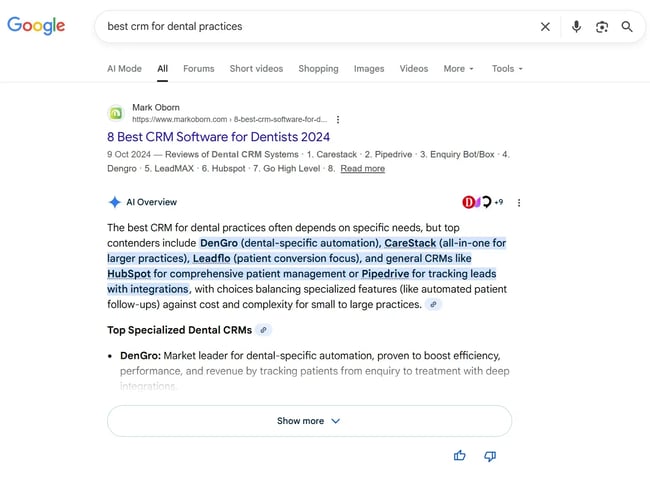
Here’s an example search term: “best crm for dental practices.”

CareStack has a prominent position in AIO, but it’s mid-page two in traditional results.
Why I like this tactic: I consistently see AI tools rely on third-party sources when buyers are comparing options. It’s always been this way. “Best for” type queries were always reserved (mostly) for third-party credibility in traditional SEO, and it makes sense. Google wanted to prioritize unbiased sources.
4. Get hyper-targeted.
AEO rewards specificity. People increasingly use AI tools to ask detailed, context-rich questions; queries are becoming less generic and more situational. Instead of searching for broad categories, buyers now ask for recommendations tailored to their industry, role, constraints, or use case.
When faced with a highly specific query, broadly positioned SaaS content becomes less competitive because it doesn’t provide enough contextual signal.
Hyper-targeted content—focused on a defined audience, industry, role, or scenario—is far more likely to be surfaced, summarized, and recommended when buyers ask niche or contextual questions.
How to do it:
- Create industry- or niche-specific pages (e.g., “CRM for dental practices,” “ERP for construction firms”)
- Align content to real buyer language, including how specific audiences describe their problems and workflows.
- Address context-heavy queries, such as compliance requirements, integrations, or operational constraints unique to a segment.
- Avoid generic positioning in favor of clear statements about who the product is designed for—and who it isn’t
- Reinforce targeting across pages, documentation, PR, and third-party listings so AI systems see consistent signals.
Relevance is the main reason why niche queries surface even smaller vendors in AI Overviews.
Going back to CareStack, in the earlier “best CRM for dental practices” example, CareStack appears prominently in AI-driven answers despite not ranking on page one in traditional search results. The product’s clear alignment with a specific audience makes it a strong match for the query, even without top organic rankings.
Why I like this tactic: Relevance and specificity are the most reliable ways to win visibility in AI-driven search. For SaaS teams, hyper-targeting doesn’t just increase exposure—it creates clearer positioning and a much stronger path to conversion. When buyers repeatedly see a product described as built for their exact use case or industry, it reduces friction, increases confidence, and makes the leap from discovery to trial far more likely.
5. Structure content so AI can extract, summarize, and cite it
Content that is clearly structured and easy to interpret is more likely to be summarized.
How to do it:
- Use explicit question-and-answer formatting for key queries buyers ask, using question-based headings with direct answers following.
- Define entities clearly, including what the product is, who it’s for, and how it differs from alternatives.
- Keep explanations concise and direct, especially for definitions, features, and use cases.
- Use consistent terminology across pages to avoid confusing AI systems
- Break content into scannable sections with clear headings and logical hierarchy
- Avoid burying key information deep in long-form copy or overly narrative sections
When information is easy for AI systems to summarize accurately, the brand is more likely to be cited during discovery and evaluation queries, increasing visibility at moments that influence shortlisting and trials.
Why I like this tactic: Well-structured content has always been important. It matters generally; it certainly matters for SEO, but some further attention on providing clarity for AEO doesn’t hurt.
One example of making an extra effort to provide clarity is through semantic triples, a tactic HubSpot uses. With semantic triples, writers define relationships between subjects, objects, and predicates. For example, “HubSpot’s AEO grader is a tool that AEO specialists use to review brand sentiment in AI search tools.”
6. Implement a well-structured schema.
A schema is a standardized format for structured data added to a webpage’s HTML. It helps search engines understand what a page represents by adding structure to the data. For AI systems, it adds or reinforces content without overwhelming the frontend or, therefore, the reader.
How to do it:
- Implement schema types aligned to page intent, such as FAQ, Product, SoftwareApplication, Review, Organization, and Article
- Ensure schema reflects visible on-page content, avoiding mismatches or over-markup
- Define entities consistently, including product names, brands, authors, and organizations
- Use schema to clarify relationships, such as who created content, what a product does, and how it’s reviewed
Schema has long supported traditional SEO, but its role in AI visibility is becoming much clearer — particularly for Google’s AI Overviews.
Molly Nogami and Ben Tannenbaum evaluated the visibility impact of strong, weak, and absent schema implementations. Their findings showed that pages with well-implemented schema consistently appeared in AI Overviews and also performed best in traditional search results. Pages with poorly implemented schema — or no schema at all — failed to appear in AI Overviews.
Why I like this tactic: I’ve loved implementing schema for years. Sometimes, brands can see the results of the schema within search in days. For example, if review schema is used on a SaaS product, review stars appear next to the organic listing. I’ve secured knowledge panels for myself and clients thanks to schema.
AEO for SaaS: Ways to track success.
Tracking AEO success requires a mindset shift. Brands are no longer getting the clicks and impressions that SEO provided. Instead, the metrics need to cover AI visibility, brand uplift, and, importantly, revenue.
Inclusion and Visibility in AI Answers
Before AI-driven discovery can influence trials or revenue, a brand needs to appear in the answers buyers actually see. Inclusion and visibility in AI-generated results are foundational indicators of whether an AEO strategy is working.
Unlike traditional rankings, AI visibility is about presence, positioning, and context. Being cited, summarized, or referenced in an answer often matters more than a page’s ranking in organic results.
To track this effectively:
- Monitor priority discovery and evaluation queries across AI Overviews and generative tools
- Record when the brand, product, or pages are cited or mentioned, even without a clickable link
- Track how AI describes the product, including category placement, use cases, and qualifiers
- Compare visibility across query types, such as awareness, comparison, and “best for” questions
- Look for consistency over time, rather than one-off appearances
Important note: I don’t think visibility is enough on its own, because it doesn’t always translate into sales. Visibility must be tracked alongside conversions and revenue. I get into that next.
Trial Signups Influenced by AI Referrals
Trial signups are the clearest signal that discovery has turned into intent. If AEO is working for the business, it will show up here, as a last-click source, but also as an influence that nudged buyers toward starting a trial once they’ve been exposed to the product in AI-driven answers.
To understand how AEO contributes to trial volume, teams can:
Monitor Referral Traffic from AI Tools
Identify sessions and trial starts coming from sources such as ChatGPT, Perplexity, and Gemini. Teams can set up tracking like this in GA4 using events. Record conversions like a button click, requesting a trial, or a form submission from people who came to the site via AI.
Form submissions are automatically recorded in GA4, but must be enabled first. To turn on form fills:
Visit GA4 > Click “Admin” (the cog in the bottom left) > Data Streams > Click your website.
This should open “web stream details” and “Enhanced Measurement,” as shown in the following screenshot. Toggle on all desired measurements to begin tracking.
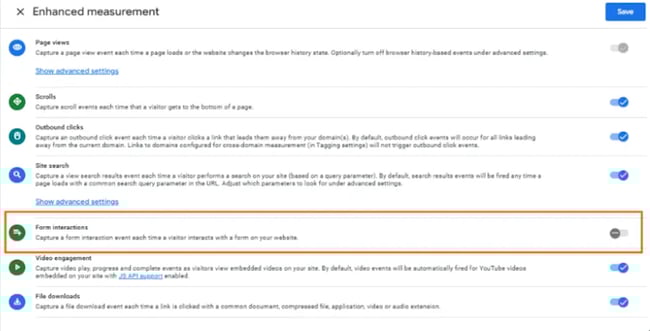
Once done, these events will show in the events report.
Pro tip: Once set up, teams can create real-time dashboards in Google Looker Studio to monitor success with a filtered view that includes only AEO traffic.
Use Assisted-Conversion Reporting
AI-driven discovery rarely results in an immediate conversion. In most SaaS journeys, buyers encounter a product in an AI-generated response early on. Then, they continue researching elsewhere and only convert later through branded search, direct traffic, or another channel. This is why AI should be treated as an assist, not a last-click source.
Instead of expecting AI traffic to convert in isolation, track how AI-driven sessions contribute to conversions over time using multi-touch attribution and audience analysis.
In GA4, one of the easiest ways to do this is with the segment overlap report. This allows teams to compare users who arrived via an AI source with users who eventually converted, showing how often the two groups overlap.
To apply this in practice:
- Create a segment for AI-driven sessions, using source or medium filters that capture traffic from tools like ChatGPT, Perplexity, and Gemini
- Create a second segment for converters, such as users who completed a trial signup or form submission
- Use the segment overlap view to identify users who first arrived via AI but converted later through another channel
This approach helps surface AEO’s real contribution. Even when AI isn’t the final touchpoint, overlap analysis shows whether AI-driven discovery is introducing qualified users who convert later — often through more traditional channels.
Branded Demand Lift
When a brand appears in an AI-generated answer, prospects may return later by searching for the brand directly, navigating to the site, or looking up product-specific terms once interest has been established.
Because AI tools often answer early questions without a click, branded demand becomes a gauge of influence. It shows that a brand has been recognized, remembered, and carried forward into the next stage of the buying journey.
To track branded demand lift effectively:
- Monitor branded search growth in Google Search Console and GA4.
- Watch product-specific query volume, such as feature names, integrations, or “{product} pricing” searches.
For SaaS teams, branded demand lift helps bridge the attribution gap created by AI search.
Pro Tip: In theory, the brand will show up for any branded search. Look for searches that include the brand name and competitors, and see if there’s anything there that can inspire content, like “the differences between,” “alternatives,” or content around how the brand handles certain features compared to competitors.
Trial-to-Paid Conversion Rate for AI-Influenced Users
Trial volume doesn’t tell the full story. Sales and monthly or annual recurring revenue matter most in SaaS. The real quantifier of AEO effectiveness is whether AI-influenced users convert into paying customers.
To measure this effectively:
- Segment users who interacted with AI-driven touchpoints, even if AI wasn’t the final conversion source. Teams may need to manage this internally by asking customers during their onboarding whether they interacted with AI during their buyer journey.
- Track trial-to-paid conversion rates for this group and compare them to organic search, paid media, and outbound-led trials
- Analyze time-to-conversion, not just conversion rate, to account for longer evaluation cycles.
- Tie conversions back to revenue, including deal size and expansion potential.
Customer Lifetime Value for AI-Influenced Users
For SaaS companies, the long-term value of a customer matters. Tracking customer lifetime value (CLV) for AI-influenced users helps determine whether AEO is attracting better-fit customers rather than just more trials.
To measure this effectively:
- Use the segmented customers from above.
- Track retention and churn rates for AI-influenced cohorts versus other acquisition channels.
- Compare expansion metrics, such as upgrades, add-ons, or seat growth.
- Measure revenue over time, not just initial contract value.
Best AEO Tools for SaaS Marketing Teams
Xfunnel
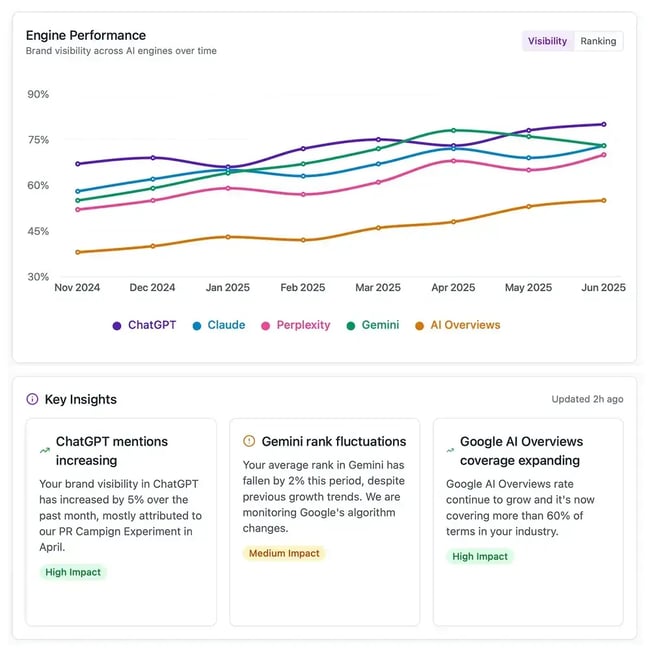
XFunnel is a platform for measuring AI search visibility and performance across large language models and AI-driven answer engines. It tracks how often a brand, product, or content is surfaced, cited, or referenced across AI environments, including tools like ChatGPT, Google AI Overviews/AI Mode, Gemini, Perplexity, Claude, and others.
Xfunnel provides AEO specialists with insights into sentiment, citation context, share of voice, and competitive positioning to help teams understand where they are visible and where gaps remain.
Why I like it: XFunnel Measure is purpose-built to measure visibility inside AI answers. It helps SaaS marketing teams understand where they’re showing up in AI-generated results, how they’re described, who sees them, and where visibility can be improved.
AEO Grader
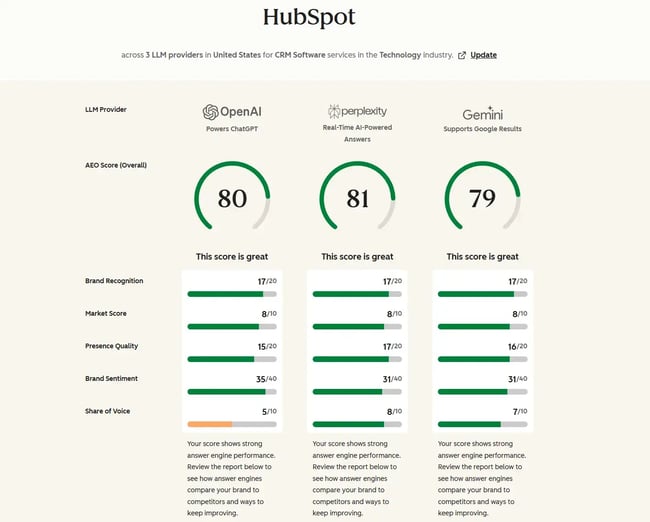
HubSpot’s AEO Grader evaluates visibility, sentiment, and consistency in AI-generated answers to highlight gaps that could limit discovery or misrepresent positioning. AEO Grader looks at how AI systems interpret a brand: what it is associated with, how it’s described, and whether the content is structured clearly enough to be extracted and cited.
AEO Grader:
- Assesses brand visibility across AI search tools and LLMs
- Highlights sentiment and positioning issues in AI-generated answers
- Flags inconsistencies in messaging or entity understanding
- Identifies opportunities to improve clarity, structure, and extractability
Why I like it: AEO Grader is quick and easy to use. It’s common to assume that if content is ranking well and the messaging is right on the site, then that will translate to AI results, but that’s not always the case. AEO grader makes AI visibility tangible, giving SaaS teams a faster way to spot misalignment before it affects evaluation, trials, or pipeline.
Semrush
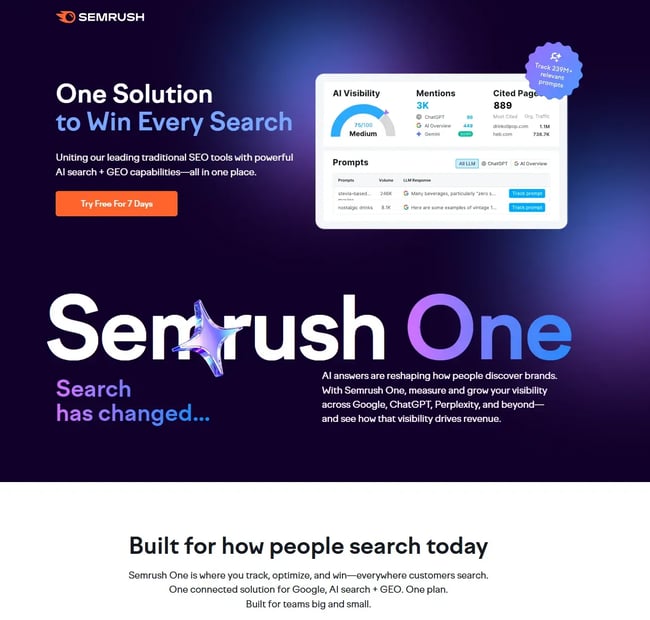
Semrush One is an all-in-one SEO and AEO platform that supports keyword research, competitive analysis, site audits, SEO rank tracking, content optimization, AI visibility, prompt monitoring, and more.
It is an expensive tool and starts at $199/month.
Why I like it: I’ve used Semrush for a long time, and overall, I think the AEO prompt tracking and AEO improvement recommendations are really good. I found the tool’s recommendations aligned with my own ideas.
Google Analytics 4
GA4 is the source of first-party truth. While it doesn’t directly measure AI visibility, it shows what actually happens on a site after AI-driven discovery — trial starts, form submissions, assisted conversions, and revenue events.
For SaaS teams, GA4 is best used to understand how AI-influenced users behave, convert, and progress through the funnel compared to users from organic search, paid media, or outbound.
Every business should use GA4, and it’s free!
Why I like it: GA4 keeps AEO grounded in reality. It shows the real business outcomes such as assisted trials, branded demand, better-qualified users, and stronger conversion paths. AEO specialists must tie AEO efforts to real business results.
Frequently Asked Questions About AEOf or SaaS.
How is AEO different from SEO for SaaS?
SEO focuses on blue link rankings, clicks, and traffic. In modern-day search, SEO targets middle- to bottom-of-funnel keywords. In contrast, AEO targets top-of-funnel keywords, surfacing them in AI channels where discovery occurs, summarization, and citations in AI-generated answers.
Should we create separate competitor comparison pages?
SaaS companies should consider creating separate pages for competitor comparisons. Dedicated comparison and alternatives pages give AI systems clear, extractable context for evaluation-stage queries. Since AI often prioritizes third-party validation for queries like this, influencing third-party publications positively where possible strengthens evaluation-stage visibility.
How do we allow AI bots without hurting site performance?
Unless a rule is added to prevent AI bots from crawling the site, they will be automatically allowed to crawl based on the rules set in the robots.txt file. It’s unclear how much AI agents pay attention to robots.txt, but some agents, like ChatGPT, have suggested they respect the disallow directives.
How do we connect AEO traffic to trials and the pipeline?
Treat AI as both an assist channel and a last-click source. Use GA4 assisted-conversion reporting, segment overlap analysis, and signals like branded demand and trial-to-paid conversion rates.
How often should we update pricing and integrations for AEO?
SaaS companies should update pricing and integrations as soon as changes occur. Fresh, accurate pricing and integration data increase the likelihood that content is trusted and cited during evaluation.
Getting Started
AEO is already shaping the SaaS industry and how buyers search, discover, evaluate, and shortlist products. The teams winning today are the ones that adapt their SEO foundations for AI-driven discovery, double down on evaluation-stage visibility, invest in third-party credibility, structure content for extraction, and measure success through trials, pipeline, and revenue.
If there’s one takeaway, it’s this: AEO only works when it’s operationalized. That means pairing visibility tools like XFunnel with diagnostics like HubSpot’s AEO Grader, grounding decisions in first-party data from GA4, and continuously aligning content, PR, and positioning to how buyers actually search and decide.










Last Comments