

AI search visibility refers to how a brand appears in AI-generated results from tools like ChatGPT and AI-augmented search engines such as Gemini or Perplexity. Unlike traditional SEO, which tracks ranking positions and blue links, AI visibility measures how often your brand is mentioned, how your owned content is cited, and how those mentions are framed in model responses.

As more users rely on direct answers instead of click-through results, a strong AI search visibility profile influences not just discovery and trust, but ultimately, conversions.
Table of Contents
- What is AI search visibility?
- How is AI search visibility different from organic search?
- AI Search Visibility: How to Start Tracking
- How to Improve Brand Visibility in AI-Generated Answers
- Improve AI search visibility with HubSpot’s AEO Grader
- Frequently Asked Questions About AI Search Visibility
What is AI search visibility?
AI search visibility is a marketing metric that measures how often and how accurately a brand appears within AI-generated answers across platforms. If SEO tells Google who you are, AI search visibility tells the internet what you mean.
Think less about “where you rank” and more about “how you’re remembered.” When someone asks ChatGPT or Perplexity who makes the best CRM platform, does your name appear? Is it linked? And does the model describe you the way you’d want a prospect to hear it? That’s basically AI visibility.
In practice, ai search visibility comes down to four signals:
- Mentions, how frequently your brand appears in AI responses tied to your key topics.
- Citations, whether those responses link back to your owned content or just describe you abstractly.
- Sentiment, whether that context reads positive, neutral, or critical.
- Share of voice, how often you appear relative to competitors across a consistent prompt set.
These are the new “positions” of 2026 — invisible on a results page, but visible everywhere else that matters.
The distinction from traditional SEO is pretty stark. SEO ranks web pages. AI search ranks knowledge. A top-ranked article in Google can be entirely absent from AI answers if the model hasn’t associated your brand with the entities or signals it trusts.
This shift is more than theoretical. AI search interfaces are already reshaping how users find information:
- Pew Research found Google’s AI Overviews appeared in 18% of U.S. desktop searches in March 2025.
- Up to 60% of searches end without a click, because the answer now lives inside the interface.
- And a growing share of younger users — 31% of Gen Z, per HubSpot’s 2025 AI Trends for Marketers report — start queries directly in AI or chat tools instead of search engines.
That means brand visibility has moved upstream from the SERP to the sentence. Visibility is no longer something you “earn” once. Brands must teach AI systems about themselves over time in a way AI can understand.
How is AI search visibility different from organic search?
AI search visibility differs from organic search because it measures how frequently and how favorably a brand is referenced within AI-generated answers, not how high its web pages appear in search results. Organic search rewards relevance, backlinks, and user behavior. AI search rewards clarity, reputation, and structured context. Instead of deciding which link to rank, large language models decide which brands to trust when synthesizing their responses.
Traditional SEO vs. AI Search Metrics
The shift from organic to AI search changes which metrics matter for brand visibility:
|
Traditional SEO |
AI Search Visibility |
|
Keyword ranking |
Brand mentions across AI prompts |
|
Backlink authority |
Citation frequency to owned content |
|
Click-through rate |
Sentiment framing within AI answers |
|
Organic share of voice |
Share of voice across models and platforms |
The Four Core AI Search Visibility Metrics Explained
1. Brand Mentions
Frequency of your brand’s appearance in AI-generated responses. Mentions reflect recall — they show whether a model recognizes your brand as relevant to a topic or category.
2. Citations to Owned Pages
Instances where an AI engine attributes information directly to your website or assets. Citations are becoming the new trust signal. Seer Interactive’s 2025 analysis found that traditional SEO strength (rankings, backlinks) showed little correlation with brand mentions in AI answers, underscoring that citation behavior is emerging as the key indicator of trust and authority.
3. Sentiment Framing
The tone and context surrounding a brand mention. Positive or neutral framing contributes to credibility and user confidence, while negative framing may suppress engagement even when the brand is visible.
4. Share of Voice Across Prompts
Your comparative visibility — how often your brand is named relative to peers when users ask similar questions across multiple AI tools. Tracking this monthly helps quantify “model recognition momentum.”
Why does this shift matter?
Answers are moving into AI environments at an accelerating pace. ChatGPT now processes over 2.5 billion prompts per day, and industry analysts expect AI-driven search traffic to surpass traditional search by 2028. This means visibility inside AI ecosystems is becoming the new baseline for brand discoverability.
Brands are already adapting to this shift. Conrad Wang, Managing Director at EnableU, explains how his team approaches AI search optimization:
“Google’s AI mode gives you a query fanout that shows where it looks for answers, and we’ve found that it often pulls data from obscure, high-trust directories and best-of lists rather than the top organic search results. We’ve built a small task force to audit these pages the AI trusts and focus our outreach on getting EnableU listed. We know it’s working because our brand mentions in AI-generated answers for local queries have increased by over 50%, even when the click-through rate is zero.”
AI search visibility depends on mentions, citations, and sentiment because LLMs use those signals to decide which brands to include in synthesized answers. The more consistently those signals appear, the more confidently AI systems can surface and recommend your brand across platforms.
AI Search Visibility: How to Start Tracking
AI search visibility tracking measures how AI engines reference a brand by capturing mentions, citations, sentiment, and share of voice across a defined set of prompts and platforms. This framework gives marketing teams a lightweight, governance-friendly process for measuring and improving AI search performance over time.
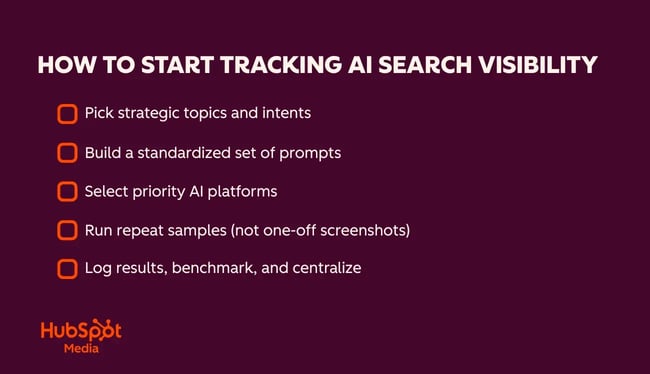
1. Pick strategic topics and intents
Start by identifying queries that actually drive revenue and influence purchasing decisions.
- Core product categories: “best B2B CRM for SMBs,” “top marketing platforms”.
- Priority use cases: “AI marketing automation tools,” “multi-channel attribution software.”
- Comparative and evaluative prompts: “HubSpot vs [competitor],” “top platforms for…”
These topics should align with existing content clusters, sales narratives, and named entities like product names, frameworks, or proprietary methodologies. Select 10-30 prompts per topic set to enable benchmarking over time without creating unmanageable volume
2. Build a standardized prompt set
After defining topics, create a consistent prompt library to test engines in a controlled format. Include patterns like:
- “Who are the leading [category] platforms?”
- “What is the best tool for [use case]?”
- “Which platforms are recommended for [audience]?”
- “What is [brand] known for in [category]?”
Standardization matters. Research published by the Association for Computational Linguistics found that even tiny changes like adding a space after a prompt can change an LLM’s response. Controlling prompts reduces noise and isolates genuine shifts in model behavior.
Store this prompt set in a shared Content Hub asset, internal wiki, or AEO playbook so marketing teams test against the same questions.
3. Select priority AI platforms
AI visibility is multi-surface. A practical baseline usually includes:
- ChatGPT — general discovery + research
- Gemini — Google ecosystem behavior
- Microsoft Copilot — enterprise and M365 users
- Perplexity — research and technical audiences
Selection should reflect where the audience actually works and searches. Start with 3–4 engines, then expand if patterns justify it.
Pro Tip: Use the HubSpot AEO Grader to establish a baseline across supported AI engines, tracking mentions, citations, and sentiment where available.
4. Run repeat samples (not one-off screenshots)
Tracking AI search visibility is about trends, not one dramatic screenshot in Slack. An operational pattern for continued sampling looks like this:
- Run each selected prompt within each engine.
- Capture responses 3–5 times per engine per prompt in the same session or day.
- Repeat this process monthly (or bi-weekly during critical campaigns).
AI models don’t give the same answer twice — a consequence of their design. Running each prompt multiple times helps marketing teams spot real trends instead of chasing random noise.
5. Log results, benchmark, and centralize
Raw answers are useless if they stay in screenshots. Teams should structure results into a simple, query-level dataset. For each prompt and engine combination, log:
- Brand mentioned? (Y/N)
- Which brands were mentioned?
- Citations to owned pages (Count and example URLs)
- Sentiment framing (Positive / Neutral / Negative)
- Position in the answer (Early / Middle / Trailing)
- Notes (hallucinations, outdated info, mis-categorization)
This can live in a shared spreadsheet, a custom Content Hub reporting view, or other AI SEO tools supporting automated scoring.
Centralized AI visibility data can feed directly into existing HubSpot dashboards and attribution workflows. From there, marketing teams can:
- Calculate the share of voice across prompts and engines.
- Flag gaps where competitors dominate mentions.
- Prioritize content, schema, and PR efforts where visibility is weakest.
- Align insights with HubSpot reporting on content engagement and influenced pipeline.
Treat this process as an extension of existing SEO and attribution reporting. AI visibility within the same operational rhythm stops being mystical and starts being measurable.
How to Improve Brand Visibility in AI-Generated Answers
Large language models learn which brands to trust by observing how clearly, consistently, and credibly those brands show up online. AI brand visibility improves when a company makes itself easy to understand, easy to cite, and easy to trust across every place models gather data — and that’s ultimately how to improve brand visibility in AI-generated answers.
Recent industry data shows that brands optimizing for AI surfaces, like ChatGPT, Gemini, and Google’s AI Overviews, are already seeing stronger engagement across social and search discovery.
In fact, BrightEdge’s September 2025 analysis found that 83.3% of AI Overview citations came from pages beyond the traditional top-10 results. This analysis suggests that structured, answer-ready content directly supports discoverability and downstream user engagement.
Start by building a foundation AI systems can actually read. Structure your content around clear entities, credible sources, and repeatable signals of authority. Then, layer in the human elements — FAQs, social proof, and community engagement — that teach large language models that your brand is both reliable and relevant. Each step reinforces the next, creating a feedback loop between how people experience your content and how AI engines describe it.
Build entity-based content clusters.
AI models map relationships. Building clusters around key entities (e.g., products, frameworks, or branded methodologies) makes those connections explicit and helps AI engines retrieve accurate associations.
As John Bonini, founder of Content Brands, notes on LinkedIn, “LLMs (seem to) reward clarity. Models surface sources that show clear thinking. People remember brands that have a consistent narrative.”
That principle sits at the heart of AI search visibility. Consistency across your entity clusters and brand language teaches models how to describe you — not just what you sell.
How to do it:
- Audit existing content by entity, not just keyword.
- Interlink pillar and subtopic pages, and support them with appropriate schema (AboutPage, FAQPage, Product schema) to highlight machine-readable relationships.
- Reinforce semantic triples like Content Hub → supports → entity governance workflows.
Create source-friendly pages.
Pages that summarize definitions early, surface key data points, and use structured lists or tables are easier for AI systems to parse and understand. While Google notes that there are no special technical requirements for AI Overviews, its guidance emphasizes that clearly structured, crawlable content remains essential for eligibility and accurate citation.
How to do it:
- Add an “answer-first” summary directly below each heading so that both readers and AI systems can instantly capture the core idea.
- Include timestamps alongside statistics — freshness signals reliability to models that prioritize recent data.
- Replace vague transitions like “many experts say” with named sources and clear attribution to reduce hallucination risk.
It’s one thing to structure content for readability; it’s another to see how that structure actually changes visibility.
“The greatest difference was when we realized that AI engines are looking for clarity of the original source, so we made certain each article included attributable data and not just opinions,” said Aaron Franklin, Head of Growth at Ylopo. “About two weeks after adding expert quotes and inline citations to our articles (and also beginning to track), we began showing up in AI-generated answers.”
Franklin’s experience underscores what Google’s guidance implies: clarity and attribution are structural signals that teach AI models which sources to trust.
Expand FAQs and conversational coverage.
FAQs mirror how people query AI — in natural language, with specific intent. Adding question-based sections improves both human readability and machine retrievability, teaching large language models to associate your brand with clear, authoritative answers.
How to do it:
- Add 3–5 contextual questions per topic page that reflect common conversational phrasing.
- Use specific subjects — “content marketers,” “RevOps teams,” “small business owners” — instead of generic “you” language to create stronger semantic signals.
- Refresh quarterly based on prompt-tracking data from ChatGPT, Gemini, and Perplexity queries to keep coverage current and relevant.
In practice, this structure helps AI systems recognize subject-matter expertise the same way readers do — by clustering questions, context, and verified answers.
“We optimized our top-performing content with clearer structure, FAQs, and schema markup to help AI models identify our expertise more easily. Within weeks, we saw our brand mentioned in AI-generated summaries and conversational queries on platforms like Perplexity,” said Anand Raj, Digital Marketing Specialist at GMR Web Team. “The real proof came from higher direct traffic and branded search lifts in HubSpot analytics, without a matching rise in ad spend.”
Raj’s results underscore how FAQs serve as lightweight training data for generative systems. When brands phrase answers conversationally and back them with data, models recommend them.
Strengthen social proof and digital PR.
AI models interpret external validation as a signal of authority. Independent mentions, interviews, and case studies give models — and buyers — confidence that a brand’s claims are credible and well-supported.
How to do it:
- Earn coverage on reputable industry, analyst, or review sites — not just high authority domains but contextually relevant ones.
- Repurpose customer success stories into short, data-rich case snippets that answer “how” and “what changed.”
- Cite proprietary research such as HubSpot’s 2025 AI Trends for Marketers to anchor your claims in brand-owned data.
In practice, digital PR and original research produce compounding trust signals. Each mention becomes another node that AI systems can connect back to your brand, improving the likelihood of inclusion in future generative results.
“We shifted budget from generic content to publishing original research reports with quotable statistics, making our brand the primary source that AI models cite when answering industry questions,” said Gabriel Bertolo, creative director at Radiant Elephant.
Bertolo notes that validation came quickly: within 60 days of publishing the first data study, Radiant Elephant appeared in 67% of AI responses related to key topics versus 8% before.
“We track this through monthly prompt testing and correlate it with a 3x increase in ‘attributable to AI discovery’ pipeline in our CRM,” Bertolo says.
Bertolo’s approach highlights a simple truth: Visibility follows credibility. Original data acts as a magnet for both journalists and algorithms, turning every external mention into a micro-citation that reinforces your authority.
Engage in active communities.
AI models learn from public conversations. Taking part in trusted communities like LinkedIn, Reddit, G2, and industry forums increases your brand’s exposure across the discourse that LLMs sample continuously. For instance, Semrush research found that Reddit generates a 121.9% citation frequency in ChatGPT responses, meaning it’s referenced more than once per prompt.
How to do it:
- Contribute expert insights, not product pitches — authority grows through participation, not promotion.
- Encourage employees and advocates to join discussions as themselves, building reputational equity.
- Align engagement with HubSpot’s Loop Marketing “Amplify” stage, which connects distributed brand activity across channels to measurable visibility outcomes.
Community engagement is a long but compounding game. Each authentic interaction becomes another data point, reinforcing who your brand helps and what it knows.
“Seeing that AI Overviews and Perplexity source heavily from Reddit, we’ve stopped just monitoring brand mentions and started strategic engagement,” says Ian Gardner, Director of Sales and Business Development at Sigma Tax Pro. “We‘re seeing a lot of progress in branded search from those communities, and with every model update, we’ve seen our AI citations rise.”
Gardner says Sigma Tax Pro deploys teammates to find and answer complex questions in niche subreddits and build visibility there. They post as themselves, with their own user flair, to build genuine authority, Gardner notes, “not to just drop links and spam communities—that would get them banned and destroy trust.”
Gardner’s approach reflects the new dynamic of AI-era credibility: Authority is distributed. The conversations happening on Reddit threads and niche forums are now feeding back into LLM training data. Brands that show up consistently with useful, verifiable contributions build unignorable visibility.
Improve AI search visibility with HubSpot’s AEO Grader.
AI search visibility is measurable now — and HubSpot’s AEO Grader shows exactly how large language models see your brand. The AEO Grader analyzes visibility across leading AI platforms like ChatGPT (GPT-4o), Gemini 2.0 Flash, and Perplexity AI, using standardized prompt sets and real-time data where available.
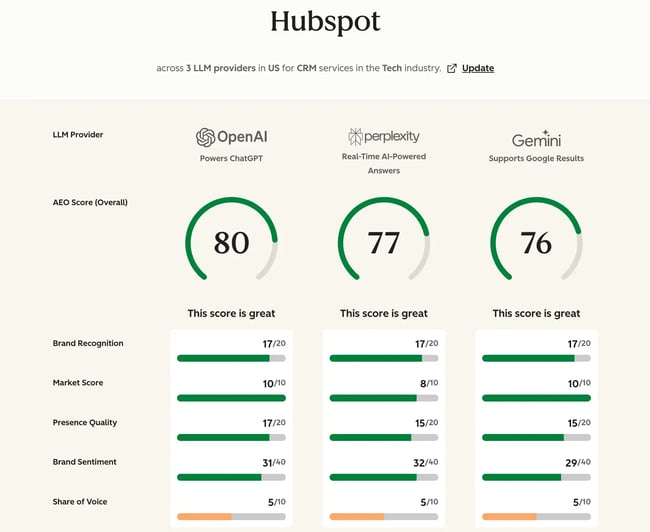
HubSpot’s AEO Grader reveals how often your brand appears in AI-generated answers, how your owned pages are cited, and how your sentiment and share of voice compare within your category.
Each report delivers five core visibility metrics:
- Brand recognition, how frequently your brand is surfaced.
- Market competition, your share of voice relative to peers.
- Presence quality, the strength and reliability of citations.
- Brand sentiment, tone and polarity across mentions.
- Contextual analysis, how consistently AI engines describe what your brand does and who it serves.
HubSpot’s AEO Grader identifies underlying factors such as mention depth, source quality, and confidence levels so teams can pinpoint what’s working — and where visibility can improve.
The result is a data-rich snapshot of visibility in AI platforms, helping marketers move from guesswork to clear performance optimization. Run the AEO Grader quarterly, or before major campaigns, to benchmark improvement and understand how AI perception changes.
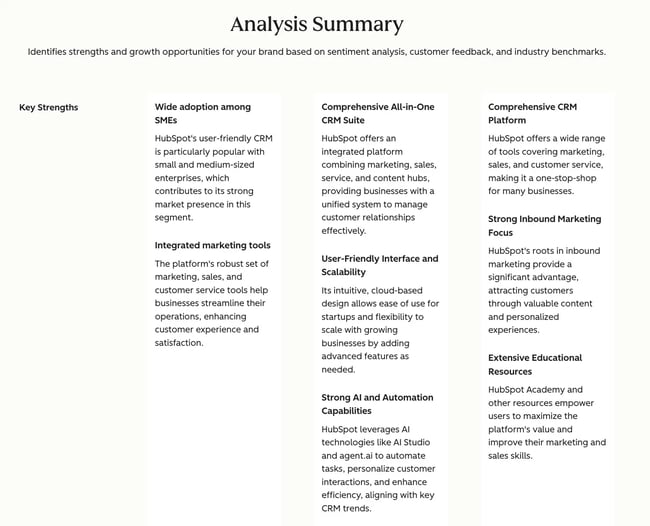
The tool also aligns naturally with HubSpot’s Loop Marketing framework: the insights you gain from AEO Grader reports fuel the Evolve stage, turning AI visibility tracking into a continuous feedback loop of learning, change, and growth.
Find your visibility on AI platforms now with HubSpot’s AEO Grader.
Frequently Asked Questions About AI Search Visibility
AI search visibility is unfamiliar territory for most marketing teams. Here’s what to know if you’re building a visibility program for 2025 and beyond.
How often should we track AI search visibility?
Track AI search visibility monthly for optimal trend analysis, with quarterly tracking as the minimum frequency. Large language models update their training data, weightings, and response generation patterns more frequently than traditional search algorithms. Running your AEO Grader monthly provides a clean trend line with enough data to identify meaningful movement without creating noise.
Do we need llms.txt or special files for AI platforms?
No, llms.txt or special AI-specific files are not currently necessary or widely supported. Unlike web crawlers that honor robots.txt, AI systems don’t currently follow a universal “robots.txt for models.” While some companies are experimenting with llms.txt, adoption remains voluntary and inconsistent.
Instead, focus on structured transparency: schema markup, clear source attribution, and accessible licensing signals. These make your content easier for models to identify and cite, which is the practical goal llms.txt tries to achieve.
Can we track AI search visibility without paid tools?
Yes, AI search visibility can be tracked manually with structured processes and consistent execution. Manual tracking starts with a spreadsheet and repeatable workflow: select prompts, test across major AI engines, log mentions and citations, and review results monthly.
Be consistent: repeat the same prompts, at the same frequency, with the same scoring rules. Teams that start manually often build better habits and intuition before layering automation.
How do we handle AI result variability across runs?
Treat AI result variability as an expected feature instead of a problem. AI systems are “non-deterministic,” meaning two identical prompts can produce slightly different answers. The key is to examine patterns across multiple runs, rather than relying on single snapshots.
Aggregate five to ten samples per prompt and record the average mention rate, sentiment, and citation frequency. That smoothing helps you separate meaningful shifts from randomness.
How do we connect AI search visibility to pipeline and revenue?
Connect AI search visibility to pipeline by treating visibility as a leading indicator of awareness and demand. When AI engines mention your brand more frequently, that recognition often appears downstream in branded search volume, direct traffic, and higher click-through rates from comparison queries.
For example, if your brand mention rate in AI answers rises from 10% to 20% over a quarter, track whether branded traffic or demo requests followed the same trajectory. While rarely a one-to-one correlation, visibility trends almost always precede awareness gains. By integrating with HubSpot’s reporting tools, the AEO Grader helps teams tie AI visibility trends to measurable outcomes like influenced contacts, content-assisted opportunities, and pipeline from AI discovery sources.
Turning AI Search Visibility Into a Growth Engine
AI search visibility has become the next arena for brand discovery — and improving AI search visibility is now a core part of how brands protect and grow their share of demand. The teams that learn to track how large language models describe them, measure sentiment and citations, and connect that data to revenue are already shaping the narratives of their industries.
HubSpot’s AEO Grader makes that visibility measurable. Content Hub turns findings into structured, answer-ready content. And Loop Marketing closes the loop by translating insights into continuous iteration: create, test, evolve, repeat.
I’ve watched this shift unfold firsthand. Marketers who started measuring their AI visibility six months ago already understand how AI defines their categories and where they need to intervene. The takeaway is simple: AI will describe your brand whether you measure it. The advantage goes to the teams that make sure models tell the right story.



![PowerPoint Tips to Present Like a Pro [Expert Advice & Free Templates]](https://firstonlineprofits.com/wp-content/uploads/2025/02/2d0b5298-2daa-4812-b2d4-fa65cd354a8e-440x58.png)






Last Comments